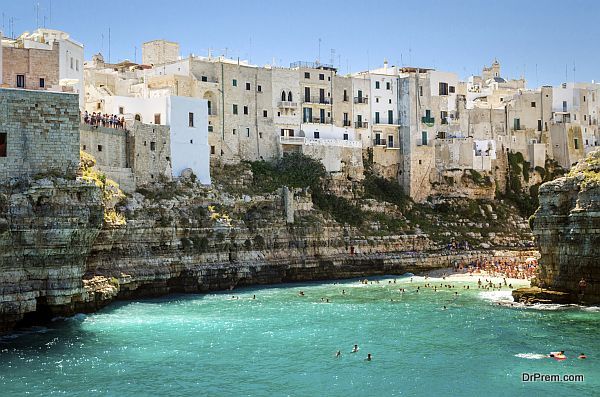
'Italy' (), officially the 'Italian Republic'; (), is located on the
Italian Peninsula in
Southern Europe, and on the two largest islands in the Mediterranean Sea,
Sicily and
Sardinia. Italy shares its northern
Alpine boundary with
France,
Switzerland,
Austria and
Slovenia. The independent states of
San Marino and the
Vatican City are enclaves within the Italian Peninsula, while
Campione d'Italia is an Italian exclave in Switzerland.
Italy has been the home of many
European cultures, such as the
Etruscans and the
Romans, and later was the birthplace of the movement of the
Italian Renaissance. Italy's capital
Rome has been the center of
Western Civilization, and is the center of
Roman Catholic Church.
Today, Italy is a democratic republic, and a
developed country with the
7th-highest GDP and the 17th-highest
Human Development Index rating in the world. It is a founding member of what is now the
European Union (having signed the
Treaty of Rome in 1957), and also a member of the
G8, the
Council of Europe, the
Western European Union, and the
Central European Initiative. Beginning
January 1,
2007, Italy became a
non-permanent member of the
United Nations Security Council. Also Italy is considered a
Great power[2], and a
Regional power.
Etymology
The origin of the term "Italy" (It: ''Italia''), from Latin ''Ītalia'', is uncertain. According to one of the more common explanations, the term was borrowed through
Greek, from
Oscan ''Víteliú'', meaning "the land of young cattle" and named for the god of cattle,
Mars[3]. The bull was a symbol of the southern Italian tribes and is often depicted goring the Roman wolf as a defiant symbol of free Italy during the
Samnite Wars.
The name ''Italia'' applied to a part of what is now
southern Italy. According to
Antiochus of Syracuse, it originally only referred to the southern portion of the
Bruttium peninsula (modern
Calabria), but by his time
Oenotria and Italy had become synonymous, and the name also applied to most of
Lucania as well. The Greeks gradually came to use the name "Italia" for a greater region, but it was not until the time of the Roman conquests that the term was expanded to cover the entire peninsula
[4].
History
Main articles: History of Italy
Prehistory to Magna Graecia
Excavations throughout Italy reveal human presence dating back to the
Palaeolithic period (the "Old Stone Age") some 200,000 years ago.
In the 8th and 7th centuries BC, driven by unsettled conditions at home,
Greek colonies were established in places as widely separated as the eastern coast of the
Black Sea and
Massilia (what is now
Marseille,
France). They included settlements in
Sicily and the southern part of the Italian Peninsula. The Romans called the area of Sicily and the foot of the boot of Italy ''
Magna Graecia'' (Latin, “Greater Greece”), since it was so densely inhabited by
Greeks[5] [6] [7].
Ancient Rome

The
Colosseum in Rome, perhaps the most enduring symbol of Italy
Main articles: Ancient Rome,
Italia (Roman Empire)
Ancient
Rome was a
civilization that grew from a small agricultural community founded on the
Italian Peninsula circa the 8th century BC to a colossal
empire straddling the
Mediterranean Sea. In its twelve-century existence, Roman civilization shifted from a
monarchy, to a
republic based on a combination of
oligarchy and
democracy, to an
autocratic empire. It came to dominate
Western Europe and the entire area surrounding the
Mediterranean Sea through
conquest and
assimilation.
'Italia', under the
Roman Republic and later
Empire, was the name of the
Italian Peninsula. During the Republic, Italia (which extended at the time from
Rubicon to
Calabria) was not a
province, but rather the territory of the city of
Rome, thus having a special status: for example, military commanders were not allowed to bring their armies within Italia, and
Julius Caesar passing the Rubicon with his legions marked the start of the civil war.
From the 3rd century, the Roman empire went into decline. The
western half of the empire, including
Hispania,
Gaul, and Italy, broke into independent kingdoms in the 5th century. The eastern empire, governed from
Constantinople, is usually referred to as the
Byzantine Empire after 476, the traditional date for the "
fall of Rome" and for the subsequent onset of the
Early Middle Ages, also known as the
Dark Ages.
The Dark Ages

The
Iron Crown with which Lombard rulers were crowned. They established a
Kingdom of Italy which lasted until 774, when it was conquered by the
Franks. Their influence on Italian political geography is plainly visible in the regional appellation
Lombardy.
In the sixth century AD the
Emperor Justinian reconquered Italy from the
Ostrogoths. The invasion of a new wave of
Germanic tribes, the
Lombards, doomed his attempt to resurrect the
Western Roman Empire but the repercussions of Justinian's failure resounded further still. For the next thirteen centuries, whilst new
nation-states arose in the lands north of the Alps, the Italian political landscape was a patchwork of feuding
city states, petty tyrannies, and foreign invaders.
For several centuries the armies and
Exarchs, Justinian's successors, were a tenacious force in Italian affairs - strong enough to prevent other powers such as the
Arabs, the
Holy Roman Empire, or the
Papacy from establishing a unified Italian Kingdom, but too weak to drive out these "interlopers" and recreate Roman Italy.
Later Imperial orders such as the
Carolingians, the
Ottonians and
Hohenstaufens also managed to impose their overlordship in Italy. But their successes were as transitory as Justinian's and a unified Italian state remained a dream until the nineteenth century.
No ultramontane Empire could succeed in unifying Italy - or in achieving more than a temporary hegemony - because its success threatened the survival of medieval Italy's other powers: the
Byzantines, the Papacy, and the
Normans. These - and the descendants of the Lombards, who became fused with earlier Italian ethnic groups - conspired against, fought, and eventually destroyed any attempt to create a dominant political order in Italy.
It was against this vacuum of authority that one must view the rise of the institutions of the Signoria and the ''
Communi''.
Comuni and Signorie
Main articles: Medieval commune,
Republic of Florence,
Republic of Venice,
Republic of Genoa

Palazzo Vecchio, originally called the ''Palazzo della Signoria''.
In Italian history the rise of the Signorie (sing.: Signoria) is a phase often associated with the decline of the medieval commune system of government and the rise of the dynastic state. In this context the word Signoria (here to be understood as "Lordly Power") is used in opposition to the institution of the Commune or city republic.
Indeed, contemporary observers and modern historians see the rise of the Signoria as a reaction to the failure of the ''Communi'' to maintain law-and-order and suppress party strife and civil discord. In the anarchic conditions that often prevailed in medieval Italian city states, people looked to strong men to restore order and disarm the feuding elites.
In times of anarchy or crisis, cities sometimes offered the Signoria to individuals perceived as strong enough to save the state. For example, the
Tuscan state of
Pisa offered the Signoria to
Charles VIII of France in the hope that he would protect the independence of Pisa from its long term enemy
Florence. Similarly,
Siena offered the Signoria to
Cesare Borgia.
Types of Signoria
The composition and specific functions of the Signoria varied from city to city. In some states (such as
Verona under the
Della Scala family or Florence in the days of
Cosimo de Medici and
Lorenzo the Magnificent) the
polity was what we would term today a
single party state in which the dominant party had vested the Signoria of the state in a single family or dynasty.
In Florence this arrangement was unofficial as it was not constitutionally formalized before the
Medici were expelled from the city in 1494.
In other states (such as the
Milan of the
Visconti) the dynasty's right to the Signoria was a formally recognized part of the ''Commune's constitution, which had been "ratified" by the People and recognized by the
Pope or the Holy Roman Empire.
Maritime Republics
Italy at this time was notable for its merchant
Republics, including the
Republic of Florence and the ''Maritime Republics''. They were city-states and they were generally
republics in that they were formally independent, though most of them originated from territories once belonging to the
Byzantine Empire (the main exceptions being Genoa and Pisa). All these cities during the time of their independence had similar (though not identical) systems of government in which the merchant class had considerable power. Although in practice these were
oligarchical, and bore little resemblance to a modern
democracy, the relative political freedom they afforded was conducive to academic and artistic advancement.
The four classic Maritime Republics in Italy are
Venice,
Genoa,
Pisa,
Amalfi and they are always given in that order, reflecting the temporal sequence of their dominance. However, other towns in Italy also have a history of being Maritime Republics, though historically less prominent. These include
Gaeta,
Ancona,
Molfetta,
Trani and, in
Dalmatia (under Italian cultural influence),
Ragusa and
Zara.
Venice and Genoa were Europe's gateway to trade with the East, and a producer of fine
glass, while Florence was a capital of
silk,
wool, banks and
jewelry. The wealth such business brought to Italy meant that large public and private artistic projects could be commissioned. The Maritime Republics were heavily involved in the
Crusades, providing support but most especially taking advantage of the political and trading opportunities resulting from these wars. The
Fourth Crusade, notionally intended to "liberate" Jerusalem, actually entailed the Venetian conquest of Zara and
Constantinople.
Each of the Maritime Republics over time had dominion over different overseas lands, including many of the islands of the
Mediterranean and especially
Sardinia and
Corsica, lands on the
Adriatic, and lands in the
Near East and
North Africa.
Renaissance
The unique political structures of late
Middle Ages Italy have led some to theorize that its unusual social climate allowed the emergence of a rare cultural efflorescence. Italy was divided into smaller
city states and territories: the
kingdom of Naples controlled the south, the
Republic of Florence and the
Papal States the center, the
Genoese and the
Milanese the north and west, and the
Venetians the east. Fifteenth-century Italy was one of the most urbanised areas in Europe. Most historians agree that the ideas that characterized the Renaissance had their origin in late
13th century Florence, in particular with the writings of
Dante Alighieri (
1265–
1321) and
Francesco Petrarch (
1304–
1374), as well as the painting of
Giotto di Bondone (
1267-
1337).
The Renaissance was so called because it was a "rebirth" of certain classical ideas that had long been lost to Europe. It has been argued that the fuel for this rebirth was the rediscovery of ancient texts that had been forgotten by Western civilization, but were preserved in some
monastic libraries and in the
Islamic world, and the translations of
Greek and
Arabic texts into
Latin.
Renaissance scholars such as
Niccolò de' Niccoli and
Poggio Bracciolini scoured the libraries in search of works by such classical authors as
Plato,
Cicero and
Vitruvius. The works of
ancient Greek and
Hellenistic writers (such as
Plato,
Aristotle,
Euclid, and
Ptolemy) and
Muslim scientists were imported into the Christian world, providing new intellectual material for European scholars.
The
Black Death in 1348 inflicted a terrible blow to Italy, killing one third of the population
[8].
The recovery from the disaster led to a resurgence of cities, trade and economy which greatly stimulated the successive phase of the
Humanism and
Renaissance (15th-16th centuries) when Italy again returned to be the centre of
Western civilization, strongly influencing the other European countries with Courts like Este in
Ferrara and De Medici in
Florence.
Foreign Domination (16th century - 19th century)
After a century where the fragmented system of Italian states and principalities were able to maintain a relative independence and a balance of power in the peninsula, in 1494 the French king
Charles VIII opened the first of a series of invasions, lasting half of the
sixteenth century, and a competition between
France and
Spain for the possession of the country. Ultimately Spain prevailed (the
Treaty of Cateau-Cambresis in 1559 recognised the Spanish possession of the
Duchy of Milan and the
Kingdom of Naples) and for almost two centuries became the
hegemon in Italy. The holy alliance between
Habsburg Spain and the Holy See resulted in the systematic persecution of any Protestant movement, with the result that Italy remained a Catholic country with marginal Protestant presence.
Austria succeeded Spain as Hegemon in Italy after the
Peace of Utrecht (1713), having acquired the State of
Milan and the Kingdom of Naples. The Austrian domination, thanks to the
Enlightenment embraced by
Habsburgic emperors, was a considerable improvement. The northern part of Italy, under the direct control of
Vienna, gained economic dynamism and intellectual fervour.
The
French Revolution and the
Napoleonic War (1796-1815) introduced the ideas of
equality,
democracy,
law and
nation. The peninsula was not a main battle field as in the past but
Napoleon (born in
Corsica in 1769, one year after the cession of the island from Genoa to France) changed completely its political map, destroying in 1799 the
Republic of Venice, which never recovered its independence. The states founded by Napoleon with the support of minority groups of Italian patriots were short-lived and did not survive the defeat of the French Emperor in 1815.
Risorgimento (1848-1870)
Main articles: Kingdom of Sardinia,
Risorgimento
The creation of the Kingdom of Italy was the result of concerted efforts by Italian nationalists and monarchists loyal to the
House of Savoy to establish a united kingdom encompassing the entire
Italian Peninsula.
The
Kingdom of Sardinia industrialized from 1830 onward. A constitution, the
Statuto Albertino was enacted in the year of revolutions, 1848, under liberal pressure. Under the same pressure, the
First Italian War of Independence was declared on Austria. After initial success the war took a turn for the worse and the Kingdom of Sardinia lost.
After the
Revolutions of 1848, the apparent leader of the Italian unification movement was Italian nationalist
Giuseppe Garibaldi. He was popular amongst southern Italians.
[9] Garibaldi led the Italian republican drive for unification in southern Italy, but the northern Italian monarchy of the
House of Savoy in the
Kingdom of Piedmont-Sardinia whose government was led by
Camillo Benso, conte di Cavour, also had the ambition of establishing a united Italian state. Though the kingdom had no physical connection to
Rome (deemed the natural capital of Italy), the kingdom had successfully challenged
Austria in the
Second Italian War of Independence, liberating
Lombardy-Venetia from Austrian rule. The kingdom also had established important alliances which helped it improve the possibility of Italian unification, such as
Britain and
France in the
Crimean War.
In 1866 Prussian Prime Minister
Otto von Bismarck offered Victor Emmanuel II an alliance with the
Kingdom of Prussia in the
Austro-Prussian War. In exchange Prussia would allow Italy to annex Austrian-controlled
Venice. King Emmanuel agreed to the alliance and the
Third Italian War of Independence began. Italy fared poorly in the war with a badly organized military against Austria, but Germany's victory allowed Italy to annex Venice. The one major obstacle to Italian unity remained Rome.
In 1870, Prussia went to war with France starting the
Franco-Prussian War. To keep the large Prussian army at bay, France abandoned its positions in Rome in order to fight the Prussians. Italy benefited from Prussia's victory against France by being able to take over the Papal State from French authority. Italian unification was completed, and shortly afterward Italy's capital was moved to Rome.
Liberalism to Fascism (1870-1922)
Main articles: History of Italy as a monarchy and in the World Wars
In
Northern Italy,
industrialisation and
modernisation began in the last part of the
nineteenth century. The
south, at the same time, was overcrowded, forcing millions of people to search for a better life abroad. It is estimated that around one million Italian people moved to other European countries such as
France,
Switzerland,
Germany,
Belgium and
Luxembourg.
Parliamentary democracy developed considerably in the
twentieth century. The Sardinian
Statuto Albertino of 1848, extended to the whole
Kingdom of Italy in 1861, provided for basic freedoms, but the electoral laws excluded the non-propertied and uneducated classes from voting. In 1913 male universal suffrage was allowed. The
Socialist Party became the main political party, outclassing the traditional liberal and conservative organisations.
In 1911,
Giovanni Giolitti's government agreed to sending forces to occupy Libya. Italy declared war on the
Ottoman Empire which held
Libya as a colony. The annexation of Libya caused nationalists to advocate Italy's domination of the
Mediterranean Sea by occupying
Greece as well as the Adriatic coastal region of
Dalmatia.
[(Bosworth (2005), pp. 49.)]
The path to a modern liberal democracy was interrupted by the tragedy of the
First World War (1914-1918), which Italy fought alongside the
United Kingdom and France. Italy was able to defeat the
Austrian-Hungarian Empire in November 1918. In that war 600,000 Italians died and the economy collapsed with high inflation and unemployment.
Fascism and World War II (1922-1945)
After the devastations of WWI, many Italian workers joined lengthy strikes to demand more rights and better working conditions. Some, inspired by the
Russian Revolution, began taking over their factories, mills, farms and workplaces. The liberal establishment, fearing a
socialist revolution, started to endorse the small
National Fascist Party, led by
Benito Mussolini, whose violent reaction to the strikes (by means of the "
Blackshirts" party militia) was often compared to the relatively moderate reactions of the government. After several years of struggle, in October
1922 the fascists attempted a coup (the "Marcia su Roma", i.e.
March on Rome); the fascist forces were largely inferior, but the king ordered the army not to intervene, formed an alliance with Mussolini, and convinced the liberal party to endorse a fascist-led government. Over the next few years, Mussolini (who became known as "Il Duce", Italian for "the leader") eliminated all political parties (including the liberals) and curtailed personal liberties under the pretext of preventing revolution.
In
1935, Mussolini declared war on
Ethiopia on a territorial pretext. Ethiopia was subjugated in a few months. This resulted in the alienation of Italy from its traditional allies, France and the United Kingdom, and its support for Nazi Germany. A first pact with Germany was concluded in
1936, and in 1938 (the
Pact of Steel). Italy supported Franco's revolution in the Spanish civil war and
Hitler's pretensions in central Europe, accepting the annexation of Austria to Germany in 1938, although the disappearance of a buffer state between Germany and Italy was unfavourable for the country.
In October 1938 Mussolini brought together the United Kingdom, France and Germany
at the expense of
Czechoslovakia's integrity.
In
April 1939, Italy occupied
Albania, a ''de-facto'' protectorate for decades, but in September
1939, after the invasion of
Poland, Mussolini decided not to intervene on Germany's side, due to the poor preparation of the armed forces. Italy entered the war in
1940 when France was beaten. Mussolini hoped that Italy would be able to win in a very short time. However, the country had a very poor army.
Italy invaded
Greece in October
1940 via Albania but was forced to withdraw after a few days. After Italy conquered
British Somalia in
1940, a counter-attack by the Allies led to the loss of the whole
Italian empire in the
Horn of Africa. Italy was also defeated by Allied forces in North Africa and was saved only by the German armed forces led by
Erwin Rommel.
After several defeats, Italy was invaded in June
1943. King Vittorio Emanuele and a group of fascists set themselves against Mussolini. In July
1943, Mussolini was arrested. As the old pre-Fascist political parties resurfaced, secret peace negotiations with the Allies were started. In September
1943, Italy surrendered. Immediately Germany invaded the country and Italy was divided for almost two years and became a battlefield. The Nazi-occupied part of the country, where a
fascist state under Mussolini was reconstituted, saw a savage civil war between
Italian partisans (''"
partigiani"'') and Nazi and fascist troops. The country was liberated on
April 25 1945. The liberation is still celebrated on
April 25.
The First Republic (1946-1992)
Main articles: History of the Italian Republic
In
1946 the
Vittorio Emanuele III's son,
Umberto II arose.
Italy became a Republic after the result of a popular
referendum held on
June 2 1946, a day celebrated since as
Republic Day. The republic won with a 9% margin. The Republican Constitution was approved and came into force on
January 1 1948.
Under the
Paris Peace Treaties of
1947, the eastern border area was annexed by
Yugoslavia. In
1954, the free territory of Trieste was divided between Italy and Yugoslavia.
In
1949, Italy became an ally of the United States, which helped to revive the Italian economy through the
Marshall Plan. Moreover, Italy became a member of the
European Economic Community, which later transformed into the European Union (
EU). In 1950s and 1960s the country enjoyed prolonged economic growth.
Italy underwent political ferment in the 1970s, which ended in the 1980s. Known as the
Years of Lead, this period was characterized by widespread social conflicts and terrorist acts carried out by extra-parliamentary movements. The assassination of the leader of the
Christian Democracy (DC),
Aldo Moro, led at the end of a "
historic compromise" between the DC and the
Communist Party (PCI). In the 1980s, for the first time, two governments were managed by a republican and a socialist (
Bettino Craxi) rather than by a member of DC.
At the end of the Lead years, the PCI gradually increased their votes thanks to
Enrico Berlinguer. The
Socialist party (PSI), led by
Bettino Craxi, became more and more critical of the communists and of the
Soviet Union; Craxi himself pushed in favour of US president
Ronald Reagan's positioning of
Pershing missiles in Italy.
In 2000, a Parliament Commission report from the
Olive Tree left-of-center coalition concluded that the strategy of tension had been supported by the United States to ''"stop the PCI, and to a certain degree also the PSI, from reaching executive power in the country".''
[10][11]
The Second Republic (1992-present)
From 1992 to 1997, Italy faced significant challenges as voters disenchanted with political paralysis, massive government debt, extensive corruption, and organized crime's considerable influence collectively called the political system
Tangentopoli. As Tangentopoli was under a set of judicial investigations by the name of
Mani Pulite (Italian for "Clean hands"), voters demanded political, economic, and ethical reforms. The Tangentopoli scandals involved all major parties, but especially those in the government coalition: between 1992 and 1994 the
DC underwent a severe crisis and was dissolved, splitting up into several pieces, among whom the
Italian People’s Party and the
Christian Democratic Center. The
PSI (and the other governing minor parties) completely dissolved.
The 1994 elections also swept media magnate
Silvio Berlusconi (leader of "
Pole of Freedoms" coalition) into office as Prime Minister. Berlusconi, however, was forced to step down in December 1994 when the ''Lega Nord'' withdrew support. The Berlusconi government was succeeded by a
technical government headed by Prime Minister
Lamberto Dini, which left office in early 1996.
In April 1996, national elections led to the victory of a center-left coalition under the leadership of
Romano Prodi. Prodi's first government became the third-longest to stay in power before he narrowly lost a vote of confidence, by three votes, in October 1998. A new government was formed by
Democrats of the Left leader and former communist
Massimo D'Alema, but in April 2000, following poor performance by his coalition in regional elections, D'Alema resigned.
The succeeding center-left government, including most of the same parties, was headed by
Giuliano Amato (social-democratic), who previously served as Prime Minister in 1992-93, from April 2000 until June 2001.
In 2001 the centre-right
formed the government and
Silvio Berlusconi was able to remain in power for a complete five year mandate, became the longest government in post-war Italy. Berlusconi participated in the
US-led military coalition in Iraq.
The last
elections in 2006 returned Prodi in the government with a slim majority (only 0,06%). In the first year of his government, Mr. Prodi has followed a cautious policy of economic liberalization and reduction of public debt.
Geography
Main articles: Geography of Italy
Topography
Italy is a long peninsula shaped like a boot, surrounded on the west by the
Tyrrhenian Sea and on the east by the
Adriatic Sea. It is bounded by
France,
Switzerland,
Austria, and
Slovenia to the north. The
Apennine Mountains form the peninsula's backbone;
the Alps form its northern boundary. The largest of its northern lakes is
Garda (143 sq mi; 370 km²); the
Po, its principal river, flows from the Alps on Italy's western border and crosses the
Padan plain to the Adriatic Sea. Several islands form part of Italy; the largest are
Sicily (9,926 sq mi; 25,708 km²) and
Sardinia (9,301 sq mi; 24,090 km²).
Volcanoes
Main articles: Volcanism in Italy
There are several active
volcanoes in Italy:
Etna the largest active volcano in Europe,
Vulcano,
Stromboli and
Vesuvius the only active volcano on mainland Europe.
Climate
Main articles: Climate of Italy
The climate in Italy is highly diverse and can be far from the stereotypical
Mediterranean climate depending on the location. Most of the inland northern areas of Italy (for example
Turin,
Milan, and
Bologna) have a
continental climate often classified as
Humid subtropical climate (
Köppen climate classification Cfa). The coastal areas of
Liguria and most of the peninsula south of
Florence generally fit the Mediterranean stereotype (
Köppen climate classification Csa). The coastal areas of the peninsula can be very different from the interior higher altitudes and valleys, particularly during the winter months when the higher altitudes tend to be cold, wet, and often snowy. The coastal regions enjoy mild winters and warm and generally dry summers, although lowland valleys can be quite hot in summer.
Government and politics
Main articles: Politics of Italy
The 1948
Constitution of Italy established a
bicameral parliament (''
Parlamento''), consisting of a
Chamber of Deputies (''Camera dei Deputati'') and a
Senate (''Senato della Repubblica''), a separate
judiciary, and an
executive branch composed of a Council of Ministers (
cabinet) (''Consiglio dei ministri''), headed by the
prime minister (''Presidente del consiglio dei ministri'').
The
President of the Italian Republic (''Presidente della Repubblica'') is elected for seven years by the parliament sitting jointly with a small number of regional delegates. The president nominates the prime minister, who proposes the other ministers (formally named by the president). The Council of Ministers must retain the support (''fiducia'') of both houses.
The houses of
parliament are popularly and directly elected through a complex electoral system (latest amendment in 2005) which combines proportional representation with a majority prize for the largest coalition (Chamber). All
Italian citizens older than 18 can vote. However, to vote for the senate, the voter must be at least 25 or older. The electoral system in the
Senate is based upon
regional representation. During the elections in 2006, the two competing coalitions were separated by few thousand votes, and in the Chamber the centre-left coalition (''L'Unione'';
English: ''
The Union '') got 345 Deputies against 277 for the centre-right one (''Casa delle Libertà''; English: ''
House of Freedoms''), while in the Senate ''l'Ulivo'' got only two Senators more than absolute majority. The
Chamber of Deputies has 630
members and the Senate 315 elected senators; in addition, the Senate includes former presidents and appointed senators for life (no more than five) by the President of the Republic according to special constitutional provisions. As of
May 15 2006, there are seven
life senators (of which three are former Presidents). Both houses are elected for a maximum of five years, but both may be dissolved by the President before the expiration of their normal term if the Parliament is unable to elect a stable government. In the post war history, this has happened in 1972, 1976, 1979, 1983, 1994 and 1996.
A peculiarity of the
Italian Parliament is the representation given to
Italian citizens permanently living abroad (about 2.7 million people). Among the 630 Deputies and the 315 Senators there are respectively 12 and 6 elected in four distinct foreign constituencies. Those members of Parliament were elected for the first time in April 2006 and they enjoy the same rights as members elected in Italy. Legislative bills may originate in either house and must be passed by a majority in both. The Italian judicial system is based on
Roman law modified by the
Napoleonic code and later statutes. The
Constitutional Court of Italy (''Corte Costituzionale'') rules on the conformity of laws with the
Constitution and is a post-World War II innovation.
Foreign relations
Main articles: Foreign relations of Italy
Italy was a founding member of the European Community--now the
European Union (EU). Italy was admitted to the
United Nations in 1955 and is a member and strong supporter of the
North Atlantic Treaty Organization (NATO), the
Organization for Economic Cooperation and Development (OECD), the General Agreement on Tariffs and Trade/World Trade Organization (GATT/WTO), the Organization for Security and Cooperation in Europe (OSCE), and the
Council of Europe. Its recent turns as rotating Presidency of international organisations include the CSCE (the forerunner of the OSCE) in 1994
G-8, the EU in 2001 and from July to December 2003.
Italy supports the United Nations and its international security activities. Italy deployed troops in support of UN peacekeeping missions in
Somalia,
Mozambique, and East Timor and provides support for NATO and UN operations in
Bosnia,
Kosovo and
Albania. Italy deployed over 2,000
Alpini troops to
Afghanistan in support of Operation Enduring Freedom (OEF) in February 2003. Italy still supports international efforts to reconstruct and stabilize
Iraq, but it has withdrawn its military contingent of some 3,200 troops, maintaining only humanitarian workers and other civilian personnel. The troops have remained in Iraq under UN mandate and at the request of the sovereign Iraqi Government until December 2006.
In August 2006 Italy sent about 3,000 soldiers to
Lebanon for the
ONU peacekeeping mission UNIFIL.
[12] Furthermore, since
2 February 2007 an Italian,
Claudio Graziano is the commander of the UN force in the country.
Military
Main articles: Military of Italy
Article 11 of the
Italian Constitution says: "Italy rejects war as an instrument of aggression against the freedoms of others peoples and as a means for settling international controversies; it agrees, on conditions of equality with other states, to the limitations of sovereignty necessary for an order that ensures peace and justice among Nations; it promotes and encourages international organizations having such ends in view".
The Italian
armed forces are divided into four branches:
★
Esercito Italiano (Army)
★
Aeronautica Militare (Air Force)
★
Marina Militare (Navy)
★
Carabinieri (Gendarmerie)
The Italian
armed forces are under the command of the Italian Supreme Defense Council, presided over by the
President of the Italian Republic. The total number of military personnel is approximately 308,000. Italy has the eighth highest
military expenditure in the world.
The 'Italian Army' (Esercito Italiano) is the ground defense force of the Italian Republic. It has recently (July 29th, 2004) become a professional all-volunteer force of 115,687
active duty personnel. Its most famous combat vehicles are
Dardo,
Centauro and
Ariete, and
Mangusta attack helicopters, recently deployed in UN missions; but the Esercito Italiano also has at its disposal a large number of
Leopard 1 and
M113 armored cars.

Agusta A129 Mangusta
The 'Aeronautica Militare Italiana' (AMI) is the
air force of Italy. It was founded as an independent service arm on the
28th March,
1923, by
King Vittorio Emanuele III as the ''
Regia Aeronautica'' (which equates to "Royal Air Force"). After
World War II, when Italy was made a
republic by referendum, the ''Regia Aeronautica'' was given its current name. Today the Aeronautica Militare has a strength of 45,879 and operates 585 aircraft, including 219 combat jets and 114 helicopters. As a stopgap and as replacement for leased
Tornado ADV interceptors, the AMI has leased 30
F-16A Block 15 ADF and four F-16B Block 10 Fighting Falcons, with an option for some more. The coming years also will see the introduction of 121
EF2000 Eurofighter Typhoons, replacing the leased F-16 Fighting Falcons. Furthermore updates are foreseen on the Tornado IDS/IDT and the AMX-fleet. The transport capacity is guaranteed by a fleet of 22 C-130Js, also a completely-new developed G222, called C-27J Spartan (12 aircrafts ordered), will enter service replacing the G222's.
The 'Marina Militare' (the ''Italian Navy'') is one of the four branches of the
military forces of Italy. It was created in 1946, as the Navy of the Italian Republic, from the
Regia Marina. Today's Marina Militare is a modern
navy with a strength of 35,261 and ships of every type, such as
aircraft carriers,
destroyers, modern
frigates, submarines, amphibious ships and other smaller ships such as oceanographic research ships.
The Marina Militare is now equipping herself with a bigger
aircraft carrier (the ''
Cavour''), new
destroyers, submarines and multipurpose
frigates. In modern times, the Marina Militare, being a member of the North Atlantic Treaty Organisation (NATO), has taken part in many coalition peacekeeping operations. The Marina Militare is considered the fourth strongest
navy of the world.
The 'Carabinieri' are the
gendarmerie and
military police of Italy. At the
Sea Islands Conference of the
G8 in 2004, the Carabinieri was given the mandate to establish a Center of Excellence for Stability Police Units (CoESPU) to spearhead the development of training and doctrinal standards for civilian police units attached to international peacekeeping missions.
[13]
Regions, provinces, and municipalities
Main articles: Regions of Italy,
Provinces of Italy,
Municipalities of Italy
Italy is subdivided into 20 regions (''regioni'', singular ''regione''). Five of these regions enjoy a
special autonomous status that enables them to enact legislation on some of their specific local matters, and are marked by an
★ . It is further divided into 109 provinces (''province'') and 8,101 municipalities (''comuni'').
| | Region | Capital | Area | Population |
|---|
| 1 | Abruzzo | L'Aquila | 10,794 km² | 1,305,000 |
| 2 | Basilicata | Potenza | 9,992 km² | 594,000 |
| 3 | Calabria | Catanzaro | 15,080 km² | 2,004,000 |
| 4 | Campania | Naples | 13,595 km² | 5,790,000 |
| 5 | Emilia-Romagna | Bologna | 22,124 km² | 4,187,000 |
| 6 | Friuli-Venezia Giulia ★ | Trieste | 7,855 km² | 1,208,000 |
| 7 | Lazio | Rome | 17,207 km² | 5,304,000 |
| 8 | Liguria | Genoa | 5,421 km² | 1,610,000 |
| 9 | Lombardy | Milan | 23,861 km² | 9,375,000 |
| 10 | Marche | Ancona | 9,694 km² | 1,528,000 |
| 11 | Molise | Campobasso | 4,438 km² | 320,000 |
| 12 | Piedmont | Turin | 25,399 km² | 4,341,000 |
| 13 | Apulia | Bari | 19,362 km² | 4,071,000 |
| 14 | Sardinia ★ | Cagliari | 24,090 km² | 1,655,000 |
| 15 | Aosta Valley ★ | Aosta | 3,263 km² | 123,000 |
| 16 | Tuscany | Florence | 22,997 km² | 3,619,000 |
| 17 | Trentino-Alto Adige/Südtirol ★ | Trento | 13,607 km² | 985,000 |
| 18 | Umbria | Perugia | 8,456 km² | 867,000 |
| 19 | Sicily ★ | Palermo | 25,708 km² | 5,017,000 |
| 20 | Veneto | Venice | 18,391 km² | 4,738,000 |
Demographics
Main articles: Demography of Italy
Population
The latest population estimate from
ISTAT (Italian Statistics Office) shows 59,131,287 inhabitants in Italy in December 2006
[5], an increase of 3 percent since 2001. Italy has the fourth largest population in the
European Union (after Germany, France and the United Kingdom), and the 22nd in the world. Gradual increase of population is mainly supplemented by immigrants and an increase in life expectancy of 79.81 years
[6]. Despite population growth, Italy is rapidly ageing. With a fertility of 1.35 children per woman
[7], almost one in five Italian inhabitants is a pensioner; if this ageing trend continues, the Italian population could shrink by a quarter by 2050.
[8]
Italy has the fifth highest population density in Europe with 196 persons per square kilometre. The highest density is in Northwestern Italy, as two regions out of twenty (Lombardy and Piedmont) combined, contain one quarter of the Italian population, where an estimated 7.4 million people live in the metropolitan
Milan area
[9]. The literacy rate in Italy is 98% overall, and school is mandatory for children aged 6 to 18
[14] Approximately two thirds of the population live in
urban areas[10], which is much lower than other
Western European nations.
Largest cities
Italian cities with a population of 300,000 or more (
ISTAT data, December
2006):
| Pos. | Common | Region | Prov. | Inhabitants |
|---|
| 1 | 'Rome' | Lazio | RM | 2,705,603 |
| 2 | 'Milan' | Lombardy | MI | 1,303,437 |
| 3 | 'Naples' | Campania | NA | 1,005,139 |
| 4 | 'Turin' | Piedmont | TO | 975,139 |
| 5 | 'Palermo' | Sicily | PA | 666,552 |
| 6 | 'Genoa' | Liguria | GE | 615,686 |
| 7 | 'Bologna' | Emilia-Romagna | BO | 373,026 |
| 8 | 'Florence' | Tuscany | FI | 365,966 |
| 9 | 'Bari | ' Apulia | BA | 325,052 |
| 10 | 'Catania' | Sicily | CT | 301,564 |
Metropolitan areas
According to the
OECD[11]., these are the major Italian metropolitan areas:
| Metropolitan area | Inhabitants |
|---|
| Milan | 7.4 million |
| Rome | 3.8 million |
| Naples | 3.1 million |
| Turin | 2.4 million |
Migration and ethnicity
During the nineteenth and twentieth centuries, Italy was a major source of immigrants to the Americas,
Australia and other countries in
Western Europe. However, Italy is now a destination for immigrants from all over the world with
Eastern Europe,
North Africa, and
Asia being the chief contributor areas. At the beginning of 2006, foreigners comprised 4.56% of the population or 2,670,514
[12] people, an increase of 268,357 or 10 percent from the previous year. In northern Italian cities, like
Padua,
Milan, and
Brescia, immigrants make up a significant portion of the population.
The most recent wave of migration has been from Eastern Europe, replacing North Africans as a major source of migrants. As of 2006, some 1,025,874 Eastern Europeans lived in Italy, 40% of the total population of migrants in Italy. According to
ISTAT, the five largest foreign nationalities in Italy are:
Albanian (348,813),
Moroccan (319,537),
Romanian (297,570),
Chinese (127,822), and
Ukrainian (107,188).
[ La popolazione straniera residente in Italia ]
Religion
Main articles: Religion in Italy
Roman Catholicism is by far the largest religion in the country. Although the Catholic Church is no longer officially the
state religion, it still plays a role in the nation's political affairs, partly due to the
Holy See's location in Rome. 87.8% of Italians identified as
Roman Catholic [13], although only about one-third of these described themselves as active members (36.8%).
Other
Christian groups in Italy include more than 700,000
Eastern Orthodox Christians [14], including 470,000 newcomers and some 180,000
Greek Orthodox, 550,000
Pentecostals and
Evangelicals (0.8%), of whom 400,000 are members of the
Assemblies of God, 235,685
Jehovah's Witnesses (0.04%)
[16], 30,000
Waldensians [17], 25,000
Seventh-day Adventists, 22,000
Mormons, 15,000
Baptists (plus some 5,000 Free Baptists), 7,000
Lutherans, 5,000
Methodists (affiliated to the Waldensian Church)
[18].
The country's oldest religious minority is the
Jewish community, comprising roughly 45,000 people. It is no longer the largest non-Christian group.
As a result of significant immigration from other parts of the world, some 825,000
Muslims [19] (1.4%) live in Italy, though only 50,000 are
Italian citizens. In addition, there are 110,000
Buddhists (0.2%)
[20] [21] , 70,000
Sikhs
[23], and 70,000
Hindus (0.1%) in Italy.
Economy
Main articles: Economy of Italy
According to GDP calculations, Italy was ranked as the seventh largest economy in the world in 2006, behind the
United States,
Japan,
Germany,
China,
UK, and
France, and the fourth largest in Europe. According to the OECD, in 2004 Italy was the world's sixth-largest exporter of manufactured goods. This
capitalistic economy remains divided into a developed industrial north, dominated by private companies, and a less developed
agricultural south. Italy's economy has an "underground" sector that is not included in the official data, which has recently been calculated by the Ministry of Finance to account for something close to one sixth of the official GDP.
Most raw materials needed by industry and more than 75% of energy requirements are imported. Over the past decade, Italy has pursued a tight fiscal policy in order to meet the requirements of the
Economic and Monetary Union and has benefited from lower interest and inflation rates. Italy joined the
Euro from its introduction in 1999.
Italy's economic performance has at times lagged behind that of its
EU partners, and the current government has enacted numerous short-term reforms aimed at improving competitiveness and long-term growth. It has moved slowly, however, on implementing certain structural reforms favoured by economists, such as lightening the high tax burden and overhauling Italy's rigid labour market and expensive
pension system, because of the economic slowdown and opposition from
labour unions.
Italy has a smaller number of world class multinational corporations than other economies of comparable size. Instead, the country's main economic strength has been its large base of small and medium size companies. Some of these companies manufacture products that are technologically moderately advanced and therefore face increasing competition from China and other emerging Asian economies which are able to undercut them on labour costs. These Italian companies are responding to the Asian competition by concentrating on products with a higher technological content, while moving lower-tech manufacturing to plants in countries where labour is less expensive. The small average size of Italian companies remains a limiting factor, and the government has been working to encourage integration and mergers and to reform the rigid regulations that have traditionally been an obstacle to the development of larger corporations in the country.
Italy's major exports are motor vehicles (
Fiat Group,
Aprilia,
Ducati,
Piaggio), chemicals, petrochemicals and electric goods (
Eni,
Enel,
Edison), aerospace and defence tech (
Alenia,
Agusta,
Finmeccanica), firearms (
Beretta) ; but the country's more famous exports are in the fields of fashion (
Armani,
Valentino,
Versace,
Dolce & Gabbana,
Benetton,
Prada,
Luxottica), food industry (
Barilla Group,
Martini & Rossi,
Campari,
Parmalat), luxury vehicles (
Ferrari,
Maserati,
Lamborghini,
Pagani) and motoryachts (
Ferretti,
Azimut).
Tourism is very important to the Italian economy: with over 37 million tourists a year, Italy is
ranked as the fifth major tourist destination in the world.
[15] (see
Tourism in Italy).
Transport
Main articles: Transport in Italy
The
railway network in Italy totals 19,394 kilometres (12,051
mi), ranking the country 16th in the world, and is operated by
Ferrovie dello Stato. High speed trains include
ETR-class trains, of which the
ETR 500 travels at 300 km/h (186 mph).
In 1991
Treno Alta Velocità SpA was created, a
special purpose entity owned by
RFI (itself owned by
Ferrovie dello Stato) for the planning and construction of
high-speed rail lines along Italy's most important and saturated transport routes. These lines are often referred as "TAV" lines. The purpose of TAV construction is to aid travel along Italy's most saturated rail lines and to add tracks to these lines, namely the Milan-Naples and Turin-Milan-Venice corridors. One of the focuses of the project is to turn the rail network of Italy into a modern and high-tech passenger rail system in accordance with updated
European rail standards. A secondary purpose is to introduce
high-speed rail to the country and its high-priority corridors. When demand on regular lines is lessened with the opening of dedicated high-speed lines, those regular lines will be used primarily for low-speed regional rail service and freight trains. With these ideas realised, the Italian train network can be integrated with other European rail networks, particularly the French
TGV, German
ICE, and Spanish
AVE systems.
There are approximately 654,676 kilometres (406,000 mi) of serviceable roadway in Italy, including 6,957 km (4,300 mi) of expressways
[24].
There are approximately 133 airports in Italy, including the two
hubs of
Malpensa International (near Milan) and
Leonardo Da Vinci International (near Rome).
There are 27 major ports in Italy, the largest is in
Genoa, which is also the second largest in the
Mediterranean Sea, after
Marseille. 2,400 kilometres (1,500 mi) of waterways traverse Italy.
Culture
Italy, as a state, did not exist until the unification of the country in 1861. Due to this comparatively late unification, and the historical autonomy of the regions that comprise the
Italian Peninsula, many traditions and customs that we now recognise as distinctly Italian can be identified by their regions of origin. Despite the political and social isolation of these regions, Italy's contributions to the cultural and historical heritage of
Europe remain immense. In fact, Italy is home to the greatest number of
UNESCO World Heritage Sites (41) to date.
Visual Art
Italy has seen many artistic and intellectual movements that spread throughout Europe and beyond, including the
Renaissance and
Baroque. Perhaps Italy's greatest cultural achievements lie in its artistic heritage, including the achievements of
Michelangelo,
Leonardo da Vinci,
Donatello,
Botticelli,
Fra Angelico,
Tintoretto,
Caravaggio,
Bernini,
Titian and
Raphael.
Literature
With the basis of the modern
Italian language established through the
Florentine poet,
Dante Alighieri, whose greatest work, the
Divina Commedia, is considered amongst the foremost literary statements produced in Europe during the
Middle Ages, there is no shortage of celebrated literary figures; the writers and poets
Boccaccio,
Giacomo Leopardi,
Alessandro Manzoni,
Tasso,
Ludovico Ariosto, and
Petrarch, whose best known vehicle of expression, the
sonnet, was invented in Italy. Prominent philosophers include
Bruno,
Ficino,
Machiavelli, and
Vico. Modern literary figures and Nobel laureates are nationalist poet
Giosuè Carducci in 1906, realist writer
Grazia Deledda in 1926, modern theatre author
Luigi Pirandello in 1936, poets
Salvatore Quasimodo in 1959 and
Eugenio Montale in 1975, satiryst and theatre author
Dario Fo in 1997
[16].
Science
In science,
Galileo Galilei made advancements toward the
scientific revolution, and
Leonardo da Vinci was the quintessential
Renaissance Man.
Italy has been the home of scientists and inventors: the physicist
Enrico Fermi, one of the fathers of
quantum theory and head of the
Manhattan Project; the astronomer
Giovanni Domenico Cassini; the physicist
Alessandro Volta, inventor of the
electric battery; the mathematicians
Lagrange and
Fibonacci; Nobel Prize in Physics laureate
Guglielmo Marconi, inventor of the
radio; and
Antonio Meucci, inventor of the
telephone.
Music
From
folk music to
classical, music has always played an important role in Italian culture. Having given birth to
opera, Italy provides many of the foundations of the classical music tradition. Instruments associated with classical music, including the
piano and
violin, were invented in Italy, and many of the existing classical music forms can trace their roots back to innovations of sixteenth and seventeenth century Italian music (such as the
symphony,
concerto, and
sonata). Some of Italy's most famous composers include the Renaissance composers
Palestrina and
Monteverdi, the Baroque composers
Corelli and
Vivaldi, the Classical composers
Paganini and
Rossini, and the Romantic composers
Verdi and
Puccini. Modern Italian composers such as
Berio and
Nono proved significant in the development of experimental and electronic music.
Sport
Popular sports include
football,
basketball (2nd national team sport since the '50s),
volleyball,
waterpolo,
fencing,
rugby,
cycling,
ice hockey (mainly in Milan, Trentino-Alto Adige and Veneto),
roller hockey and
F1 motor racing.
Winter sports are popular, with Italians competing in international games and Olympic venues. Sports are incorporated into Italian festivities like
Palio (see also
Palio di Siena), and the
Gondola race (
regatta) that takes place in Venice on the first Sunday of September.
Sports venues have extended from the
Gladiatorial games of
Ancient Rome in the
Colosseum to the
Stadio Olimpico of contemporary Rome, where football clubs compete.
Languages
Main articles: Languages of Italy
The official language of Italy is
Standard Italian, a descendant of
Tuscan dialect and a direct descendant of
Latin. Some 75 percent of Italian words are of Latin origin.
When Italy was unified in 1861 Italian existed mainly as a
literary language. Many
Romance regional languages were spoken throughout the Italian Peninsula (
Italian dialects), with local variants.
Following Italian unification
Massimo Taparelli, marquis d'Azeglio, one of
Cavour's ministers, is said to have stated that having created Italy, all that remained was to create Italians (a
national identity). The
Tuscan dialect (or ''
Florentine dialect'') spoken in
Tuscany was promoted as the standard dialect in large part due to its literary heritage (
Dante's ''
Divine Comedy'' is often credited with the emergence of the Tuscan dialect as standard).
Pietro Bembo, influenced by
Petrarch, also promoted Tuscan as the standard literary language (''volgare illustre''). The spread of the
printing press and
literary movements (such as petrarchism and
bembismo) also furthered Italian standardization.
The establishment of a national education system led to a decrease in variation in the languages spoken across the country. Standardization was also hastened in the 1960s because of economic growth leading to the popularization of
television (the
state broadcaster RAI set an Italian standard).
Today, despite regional variations in the form of
accents and
vowel emphasis, Italian dialects are almost always
mutually intelligible. Nevertheless
variety remains, and is often used in
idioms and
folk songs.
Some languages spoken in Italy are not considered Italian dialects but are different languages entirely, such as
Venetian,
Neapolitan,
Sicilian and other Gallo-Italian languages of the north.

Dialects and languages of Italy
In addition to the regional linguistic varieties and dialects of standard Italian, a number of languages enjoying some form of official recognition are spoken:
★ In Sardinia there is the largest group of non-Italian speakers, some 1.3 million people, they speak
Sardinian, a Romance language which retains pre-Latin words.
★ In the north, the
province of Bolzano-Bozen has a majority
German-speaking population (
Upper German). This area was taken from
Austro-Hungary and given to Italy under the terms of the 1919
Treaty of Saint-Germain-en-Laye after the
World War I. Some German-speaking communities also exist in other parts of
north Italy.
Cimbrian is a German language related to
Austro-Bavarian spoken in some parts of
Veneto (
Asiago,
Luserna) and the
Walsers in Val'Aosta (
Gressoney). In total some 300,000 or so Italians speak German as their first language. Some identify themselves as
ethnic Austrians.
★ Some 120,000 people live in the
Aosta Valley region, where a dialect of
Franco-Provençal is spoken that is similar to dialects spoken in
France. About 1,400 people living in two isolated towns in
Foggia speak another dialect of Franco-Provençal.
★ About 80,000
Slovene-speakers live in the north-eastern region of
Friuli-Venezia Giulia near the border with Slovenia.
★ In the
Dolomite mountains of
Trentino-Alto Adige/Südtirol and
Veneto there are some 40,000 speakers of the
Rhaeto-Romance language
Ladin.
★ A community of 700,000 in
Friuli speak
Friulian, also a Rhaeto-Romance language.
★ In the
Molise region of central-south Italy some 4,000 people speak
Molise Croatian. These are the
Molise Croats, descendants of a group of people who migrated from the Balkans in the Middle Ages.
★ Scattered across
southern Italy (
Salento and
Calabria) are some 30,000
Greek-speakers—considered to be the last surviving traces of the region's
Magna Graecia heritage. They speak a Greek dialect,
Griko.
★ Some 15,000
Catalan speakers reside around the area of
Alghero in the north-west corner of
Sardinia—believed to be the result of a migration of a large group of Catalans from
Barcelona.
★ The
Arbëreshë, of whom there are around 100,000 in southern Italy and in central
Sicily, the result of past migrations, are speakers of the Arbëresh dialect of
Albanian.
Notes
According to Mitrica, an October 2005 Romanian report estimates that 1,061,400 Romanians are living in Italy, constituting 37.2% of 2.8 million immigrants in that country
[17] but it is unclear how the estimate was made, and therefore whether it should be taken seriously.
See also (in Italian): ''L. Lepschy e G. Lepschy, La lingua italiana: storia, varietà d'uso, grammatica, Milano, Bompiani''
Official French maps show the border detouring south of the main summit, and claim the highest point in Italy is Mont Blanc de Courmayeur (4,748 m), but these are inconsistent with an 1861 convention and topographic watershed analysis.
References
1. Istat - Monthly demographic balance (January–December 2006)
2. see for example The Long War Against Corruption, , Ben W., Heineman, Foreign affairs, ; which speaks of Italy as a major country or "player" along with Germany, France, Japan, and the United Kingdom.
3. Mallory, J.P. and D.Q. Adams, ''Encyclopedia of Indo-European Culture''. London: Fitzroy and Dearborn, 1997: p. 24
4. Guillotining, M., History of Earliest Italy, trans. Ryle, M & Soper, K. in Jerome Lectures, Seventeenth Series, p.50
5. Luca Cerchiai, Lorena Jannelli, Fausto Longo, Lorena Janelli, 2004. ''The Greek Cities of Magna Graecia and Sicily'' (Getty Trust) ISBN 0-89236-751-2
6. T. J. Dunbabin, 1948. ''The Western Greeks''
7. A. G. Woodhead, 1962. ''The Greeks in the West''
8. Stéphane Barry and Norbert Gualde, "The Biggest Epidemics of History" (La plus grande épidémie de l'histoire, in L'Histoire n°310, June 2006, pp.45-46
9. (Smith, Dennis Mack (1997). ''Modern Italy; A Political History''. Ann Arbor: The University of Michigan Press. ISBN 0472108956, pp. 15.)
10.
11. ///
12. "Italian soldiers leave for Lebanon Il Corriere della Sera, 30 August 2006
13. http://www.usip.org/pubs/usipeace_briefings/2006/coespu.pdf
14. Society and Culture.
15. International Tourism Receipts
16. All Nobel Laureates in Literature
17. Mitrica, Mihai Un milion de romani s-au mutat in Italia ("One million Romanians have moved to Italy"). ''Evenimentul Zilei'', October 31 2005. Visited April 11 2006.
:''Other references can be found in the more detailed articles linked to in this article.''
External links
Government
★
Italia.it Official Tourism Website
★
President of the Republic of Italy
★
Parliament
★
Chamber of Deputies
★
Senate
★
Main Institutional Portal
★
Council of Ministries
★
Constitutional Court
★
Supreme Court
★
Court of Accounts
★
Ministry of Foreign Affairs
★
Ministry of the Interior
★
Ministry of Education
★
Ministry of Education - International Exchanges
★
Ministry of Health
★
Ministry of Defence
★
Ministry of Labour and Social Welfare
★
Ministry for Economic Development
★
Ministry of Agriculture
★
Ministry of Justice
Public institutions
★
National Statistics Office
★
ENIT Italian State Tourism Board
★
Italian Railways
★
Italian National and Regional Parks
Additional profiles
★
by the BBC News
★
by the CIA Factbook
★
by the Economist
★
by the U.S. Department of State
★
by the Italian Hotels Industry
Others
★
History of Italy: Primary Documents
★
List and maps of archaeological sites in Italy
★
WWW-VL: History: Italy at IUE
; Photos
★
Europe Pictures - Italy Photos from all parts of Italy
★
Pictures of Italy
Travel
★